

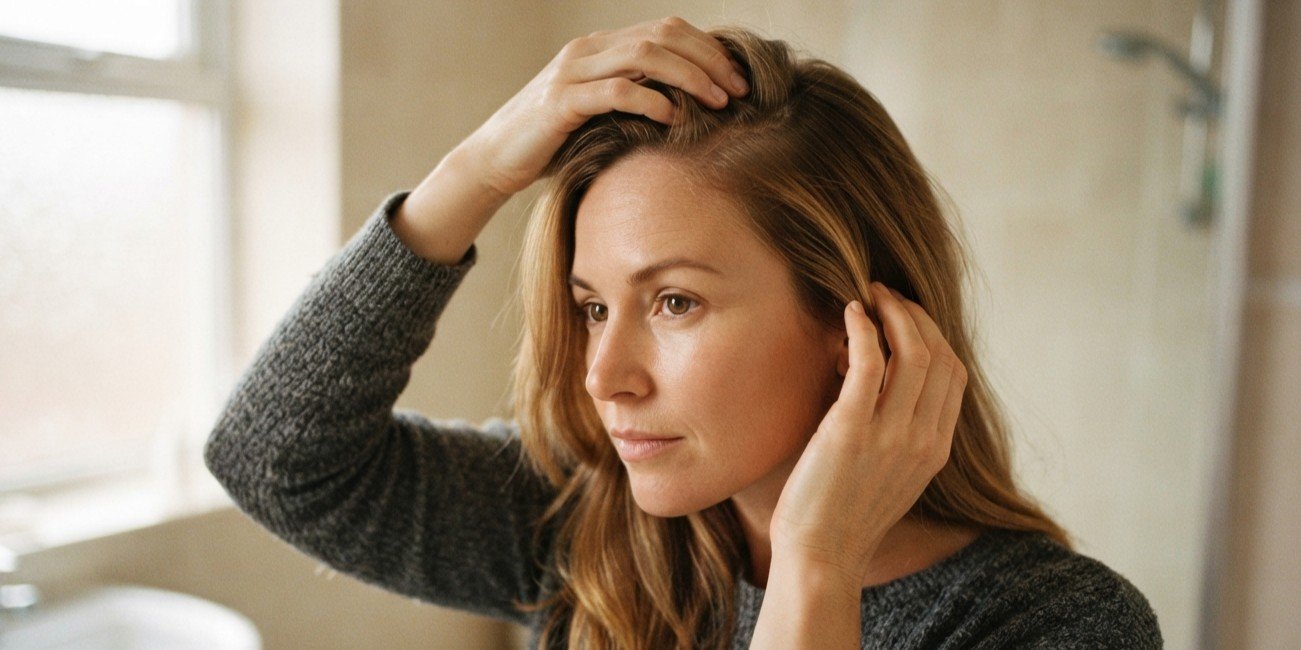
Finding extra strands on your pillow, in the shower drain, or tangled in your hairbrush can trigger instant panic, but not all hair loss is the same. Understanding female pattern hair loss vs shedding is the first step toward getting the right diagnosis, the right treatment, and peace of mind.
Many women confuse ordinary shedding with a more chronic condition called female pattern hair loss (FPHL), and this confusion often delays proper care by months or even years. This guide breaks down the science, the visual differences, and the exact diagnostic steps dermatologists use to tell the two apart.
Key Takeaways
- Shedding (Telogen Effluvium) is usually temporary, triggered by stress, illness, or hormonal shifts, and resolves within 3–6 months.
- Female Pattern Hair Loss (FPHL) is a chronic, progressive condition caused by genetics and hormone sensitivity (androgens), typically presenting as gradual thinning at the crown and widening part.
- The “60-strand test” and part-width comparison are simple at-home ways to gauge severity before seeing a professional.
- A dermatologist uses trichoscopy, pull tests, and blood work to accurately diagnose the underlying cause.
- Early diagnosis significantly improves treatment outcomes, especially for FPHL, which does not reverse on its own.
What Is Normal Hair Shedding?
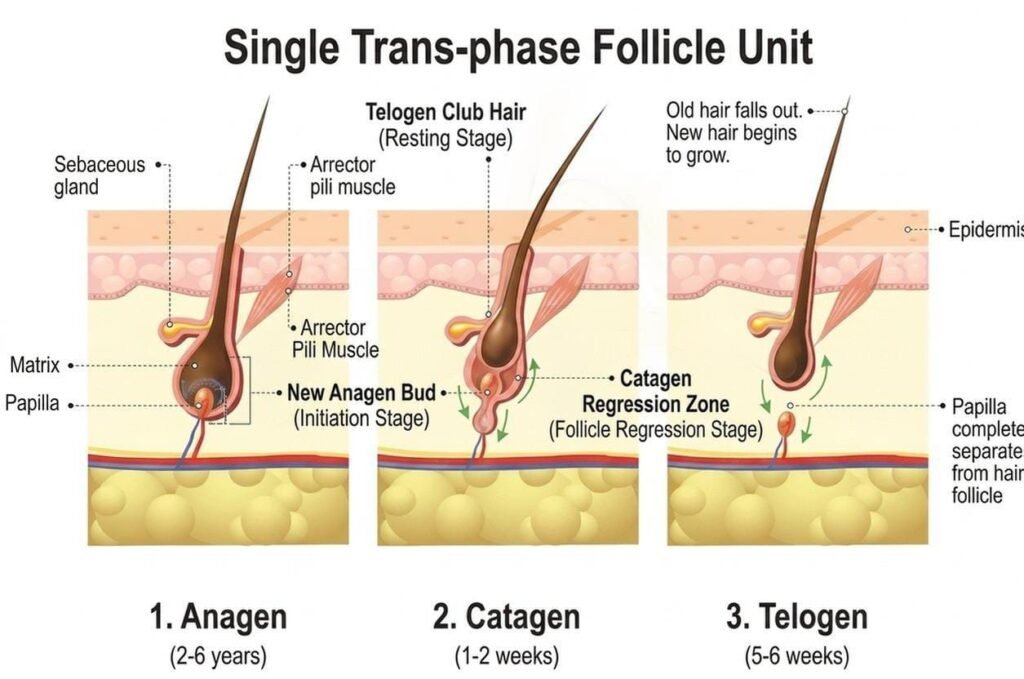
Every person naturally sheds hair as part of the hair growth cycle. On average, losing 50 to 100 hairs per day is considered normal, as hair moves through three phases: anagen (growth), catagen (transition), and telogen (resting/shedding).
When shedding increases significantly beyond this baseline often due to a stressor it’s called Telogen Effluvium (TE). This is a reactive, temporary condition, not a permanent form of hair loss.
Common Triggers of Telogen Effluvium
- Physical stress (surgery, illness, extreme dieting)
- Emotional or psychological stress
- Postpartum hormonal shifts
- Sudden weight loss or nutrient deficiency
- Starting or stopping certain medications
- High fever or infection
What Is Female Pattern Hair Loss (FPHL)?
Female Pattern Hair Loss, also known as androgenetic alopecia, is a chronic and progressive condition driven primarily by genetics and sensitivity to androgens (male hormones present in all women in smaller amounts). Unlike shedding, FPHL does not resolve on its own and tends to worsen gradually over time without intervention.
Rather than causing hair to fall out all over the scalp evenly, FPHL follows a distinct pattern:
- Gradual widening of the center part
- Thinning concentrated at the crown
- Preserved frontal hairline (in most cases)
- Reduced hair density and finer hair shaft diameter over time
Female Pattern Hair Loss vs Shedding: Side-by-Side Comparison
| Feature | Telogen Effluvium (Shedding) | Female Pattern Hair Loss |
|---|---|---|
| Onset | Sudden, often 2–3 months after a trigger | Gradual, over months to years |
| Duration | Temporary (3–6 months) | Chronic and progressive |
| Pattern | Diffuse, all over the scalp | Concentrated at crown and part line |
| Cause | Stress, illness, hormonal shifts | Genetics + androgen sensitivity |
| Regrowth | Usually resolves on its own | Requires ongoing treatment |
| Hair shaft | Normal thickness | Progressive miniaturization (thinner strands) |
How to Tell the Difference: Diagnostic Signs to Watch For
1. The Part-Width Test
Take a photo of your part line monthly. A widening part over time is a hallmark sign of FPHL, whereas shedding typically doesn’t change your part’s width — it just reduces overall volume temporarily.
2. The 60-Strand Pull Test
Dermatologists often ask patients to gently pull a section of about 60 hairs. Losing more than 10% (roughly 6+ strands) may indicate active shedding. This test alone doesn’t diagnose FPHL but helps assess active hair loss severity.
3. Hair Shaft Diameter (Miniaturization)
One of the clearest diagnostic markers of FPHL is hair shaft miniaturization — hairs becoming progressively finer and shorter with each growth cycle. This is typically assessed via trichoscopy (a magnified scalp examination) and is not present in typical telogen effluvium.
4. Timeline and Trigger Correlation
Ask yourself: did the increased shedding start 2–3 months after a specific stressor (illness, surgery, childbirth, crash diet)? If yes, it strongly points toward telogen effluvium rather than FPHL.

Professional Diagnostic Methods
While at-home tests offer useful clues, an accurate diagnosis requires clinical evaluation. Dermatologists and trichologists typically use:
- Trichoscopy – magnified scalp imaging to assess follicle density, miniaturization, and scarring
- Pull test and wash test – quantifying active shedding
- Scalp biopsy (in ambiguous or severe cases) – to rule out scarring alopecia or other conditions
- Blood panel – checking ferritin, thyroid function (TSH), and hormone levels to rule out reversible causes
According to the American Academy of Dermatology, early and accurate diagnosis of hair loss type is critical because treatment approaches for FPHL and telogen effluvium differ significantly.
Can You Have Both at the Same Time?
Yes — this is more common than most people realize. A woman with underlying, early-stage FPHL can experience a superimposed telogen effluvium episode triggered by stress or illness, temporarily accelerating visible thinning. This is why a professional evaluation is so valuable: it separates the temporary shedding layer from the chronic underlying pattern loss.

When to See a Doctor
Consider booking a dermatology appointment if you notice:
- Shedding that persists beyond 6 months
- A visibly widening part or thinning crown
- Hair loss accompanied by scalp itching, redness, or scarring
- Sudden, patchy hair loss (which may indicate alopecia areata, a separate condition)
Conclusion
Understanding female pattern hair loss vs shedding empowers you to respond appropriately instead of panicking or ignoring early warning signs. While ordinary shedding is usually self-resolving, FPHL requires early, proactive management to slow progression and preserve density. If you’re unsure which category your hair loss falls into, a proper diagnostic evaluation — including trichoscopy and blood work — is the most reliable path to clarity and an effective treatment plan.
Frequently Asked Questions
Q: How can I tell if I have female pattern hair loss or just stress shedding? A: FPHL typically shows a widening part and crown thinning that worsens gradually, while stress-related shedding is diffuse, temporary, and often tied to a specific trigger 2–3 months prior.
Q: Does female pattern hair loss ever go away on its own? A: No. Unlike telogen effluvium, FPHL is progressive and requires ongoing treatment (such as minoxidil or anti-androgens) to manage and slow further thinning.
Q: How long does normal shedding last before it’s considered a problem? A: If increased shedding continues beyond 6 months without improvement, it’s worth seeing a dermatologist to rule out an underlying chronic cause like FPHL.
Q: Can blood tests diagnose the type of hair loss I have? A: Blood tests can’t diagnose FPHL directly, but they help rule out reversible causes like iron deficiency or thyroid imbalance that may be contributing to or mimicking hair loss.
Q: Is it possible to have both shedding and pattern hair loss simultaneously? A: Yes, a stress-triggered shedding episode can occur on top of existing, early-stage FPHL, which is why professional diagnosis is important for an accurate picture.

2 thoughts on “Female Pattern Hair Loss vs. Shedding: Clinical Differences”